Unless you’ve spent the entire summer in a darkened room with the curtains closed, you probably don’t need me to tell you that it has been hot.
And dry. Very, very dry.
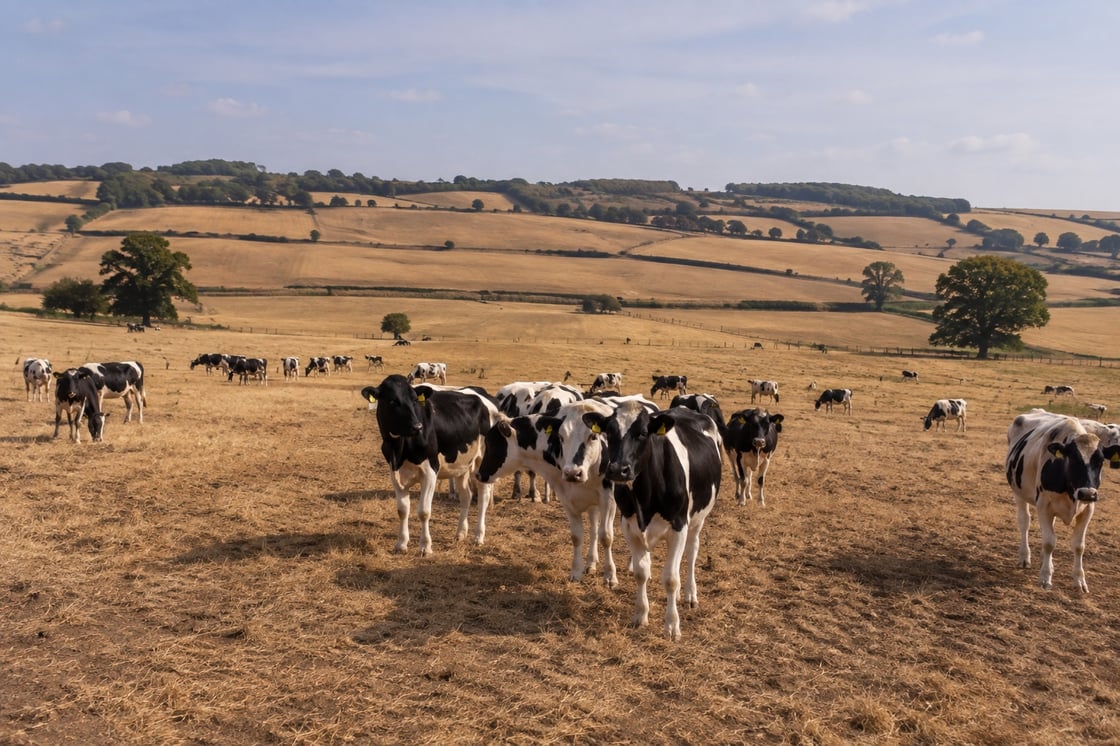
At the time of writing, almost three-quarters of England is officially in drought, following the driest July in England and Wales for 190 years. Fields that should be green are brown, grass growth has slowed dramatically and some livestock farmers are already having to feed forage they would normally have saved for winter.
There are obviously huge implications for farming. But, being me, I’ve also been thinking about the cheese. Because here’s the interesting bit. Some of the Cheddar being made during this extraordinary summer won’t be eaten for another year. And that got me wondering…
Will we be able to taste the summer of 2026 in the cheese of 2027?
After all, cheese begins with grass
It is very easy to think of milk as a consistent ingredient. Milk is milk, surely? Except it isn’t.
Milk changes throughout the year. What the cows are eating, the stage of lactation, the breed of cow, the weather and how the animals are managed can all influence both the amount of milk produced and its composition. And this summer has certainly given dairy farmers something to contend with.
When it’s very hot, cows can experience heat stress. They may eat less and produce less milk, and research has also shown that heat stress can affect aspects of milk composition, including protein.
Then there’s the grass.
Normally, grazing cows would be making the most of summer pasture. But grass needs water to grow, and after prolonged periods without meaningful rainfall, there simply isn’t the same amount available. That can mean farmers need to supplement what their cows are eating, or start using conserved forage much earlier than they would like. None of this means there is anything wrong with the milk. It means it may be different. And when you’re making cheese, those differences matter.
This is one of the things I love about artisan cheese. Cheesemakers don’t work with a completely standardised raw material arriving from a factory. They work with milk. And milk changes. A good cheesemaker understands their milk and responds to it.
They might notice differences in how quickly the curd forms, how it behaves in the vat, how much moisture it retains or the yield they get from a day’s milk.
That’s part science, part skill and, I suspect, part of that wonderful knowledge that comes from making the same cheese thousands and thousands of times. You know when something is slightly different. And then comes the really fascinating part. You put the cheese away.
See you next year…
Imagine a traditional Cheddar being made this week. The cows producing that milk have experienced this summer. The farmer has had to manage the pasture, feed and herd through these conditions. The cheesemaker then takes that milk and does everything they can to turn it into the cheese they know and love.
The cheese is wrapped, put into the maturation room… and we wait. For months. Perhaps a year. Perhaps considerably longer. While we’re putting the summer of 2026 behind us, that cheese is slowly changing. Its proteins are breaking down. Its fats are breaking down. Its texture is developing and its flavours are becoming more complex. And eventually, sometime in 2027, somebody like me will cut into it. Which is quite an extraordinary thought.
Sort of.
People are completely comfortable with the idea of a vintage in wine.
We understand that the weather in a particular year can affect the grapes and ultimately influence what’s in the bottle. Cheese isn’t quite the same.
I certainly wouldn’t suggest that we start sticking “Vintage 2026” on every piece of Cheddar and discussing whether it was a particularly good year. There are far too many other variables involved. The cheesemaker, cultures, recipe, milk source, maturation conditions and the decisions made throughout the cheese’s life all have an enormous influence on the finished product. But I do think there’s something useful in the comparison.
Cheese comes from agriculture. And agriculture is affected by the weather.
Sometimes, surrounded by stainless steel vats, maturation rooms and beautifully wrapped pieces of cheese on a shop counter, it’s surprisingly easy to forget that.
This is where I’m going to give you the slightly annoying answer:
Maybe.
I can’t tell you that the Cheddars made during this summer will have a particular flavour. I can’t say they’ll be nuttier, fruitier, more savoury or more intense. And anyone who confidently tells you exactly what the drought will taste like in a piece of Cheddar twelve months from now is getting a little ahead of themselves.
There are simply too many variables. What we can say is that hot weather and drought affect dairy farming. Heat stress can reduce milk production and influence milk composition, while poor grass growth changes the feeding decisions farmers have to make. The cheesemakers then have to work with the milk that summer gives them. And that’s the bit I find fascinating.
We tend to expect food to taste exactly the same every time we buy it. And with some foods, that’s the whole idea. But I think we should allow artisan cheese a little more freedom. Of course, if I buy a Montgomery’s Cheddar, I expect it to taste like Montgomery’s. If I buy a Quicke’s, a Keen’s or any of the other wonderful traditional Cheddars we sell, I expect it to have the character of that cheese. But I don’t necessarily want every batch to be identical. Sometimes one is a little more savoury. Another has more of those wonderful brothy flavours. One might be particularly nutty, while another has that lovely bright acidity running through it.
That’s not necessarily inconsistency. Sometimes that’s just cheese. And when you know that what you’re eating began with animals, pasture, weather and people rather than a production line, those little differences become part of what makes it interesting.
So, eventually, it will rain. The fields will turn green again. We’ll stop talking about hosepipe bans, reservoirs and how ridiculously hot it is. And summer 2026 will become one of those summers we talk about afterwards.
“Do you remember how dry it was?”
But somewhere in a maturation room, there will be cheeses quietly sitting on shelves. Cheeses made from milk produced right now. They’ll be turned and checked and looked after as autumn arrives, then winter, then spring. And eventually some of them will make their way to cheese counters like ours. By then, we’ll be thinking about an entirely different summer. So when we’re tasting mature Cheddar next year, I think I’ll be paying particularly close attention. Not because I’m expecting to taste sunshine. Or drought. Or brown fields. But because cheese is a product of farming, and farming is a product of its environment. What happens in the field doesn’t simply disappear when the milk reaches the cheesemaking vat.
Somewhere along the way, it becomes part of the story. By next summer, we may have forgotten just how dry the fields looked in August 2026.
The cheese hasn’t.