One of the things I love most about cheese is that you never really finish learning about it.
I’ve been working with cheese every day for more than ten years now. I’ve visited cheesemakers, stood in make rooms, wandered around maturation stores, judged at cheese awards, eaten an extraordinary amount of cheese in the name of education and asked cheesemakers more questions than they probably ever wanted to answer.
And I’m still learning. I think the more you know about cheese, the more you realise how much there is still to know. Which is one of the reasons I love the Academy of Cheese.
The Academy of Cheese was created to provide structured cheese education for everyone from enthusiastic cheese eaters to people working professionally within the industry.
And I think that word structured is important.
You can learn an enormous amount simply by eating cheese (an approach I wholeheartedly support) but the Academy gives you a framework for understanding why cheeses are different.
Once you start understanding some of that, eating cheese becomes even more interesting.
Learning about cheese shouldn’t make you frightened of saying the wrong thing. Quite the opposite. There are few things guaranteed to take the fun out of a cheeseboard faster than worrying that everyone else knows something you don’t.
Good cheese education should give you confidence. You don’t need to come up with elaborate tasting notes or identify seventeen different aromas. If a cheese reminds you of buttered toast, mushrooms, hazelnuts or your grandmother’s old pantry, that’s great.
Taste is personal. The important thing is learning to stop for a moment and think about what you’re tasting — and perhaps beginning to understand why those flavours are there.
The Academy has four levels of study, starting with Level One and working all the way through to Master of Cheese.
Level One is the perfect introduction. You learn the fundamentals: how cheese is made, the different styles of cheese, how to taste it properly, how to look after it and, of course, you get to taste plenty along the way.
Level Two takes things considerably further. We start digging deeper into cheesemaking, maturation, milk, microbiology, provenance, selling and caring for cheese.
And this is where I think things get really interesting. Suddenly you’re not simply looking at a piece of cheese.
You’re looking at the milk it came from. The animal that produced that milk. What it ate. The decisions made by the cheesemaker. The cultures that were added. The way the curd was handled. The salt. The rind. The maturation. All of those tiny decisions eventually end up in the piece of cheese sitting in front of you.
That’s rather wonderful when you think about it.
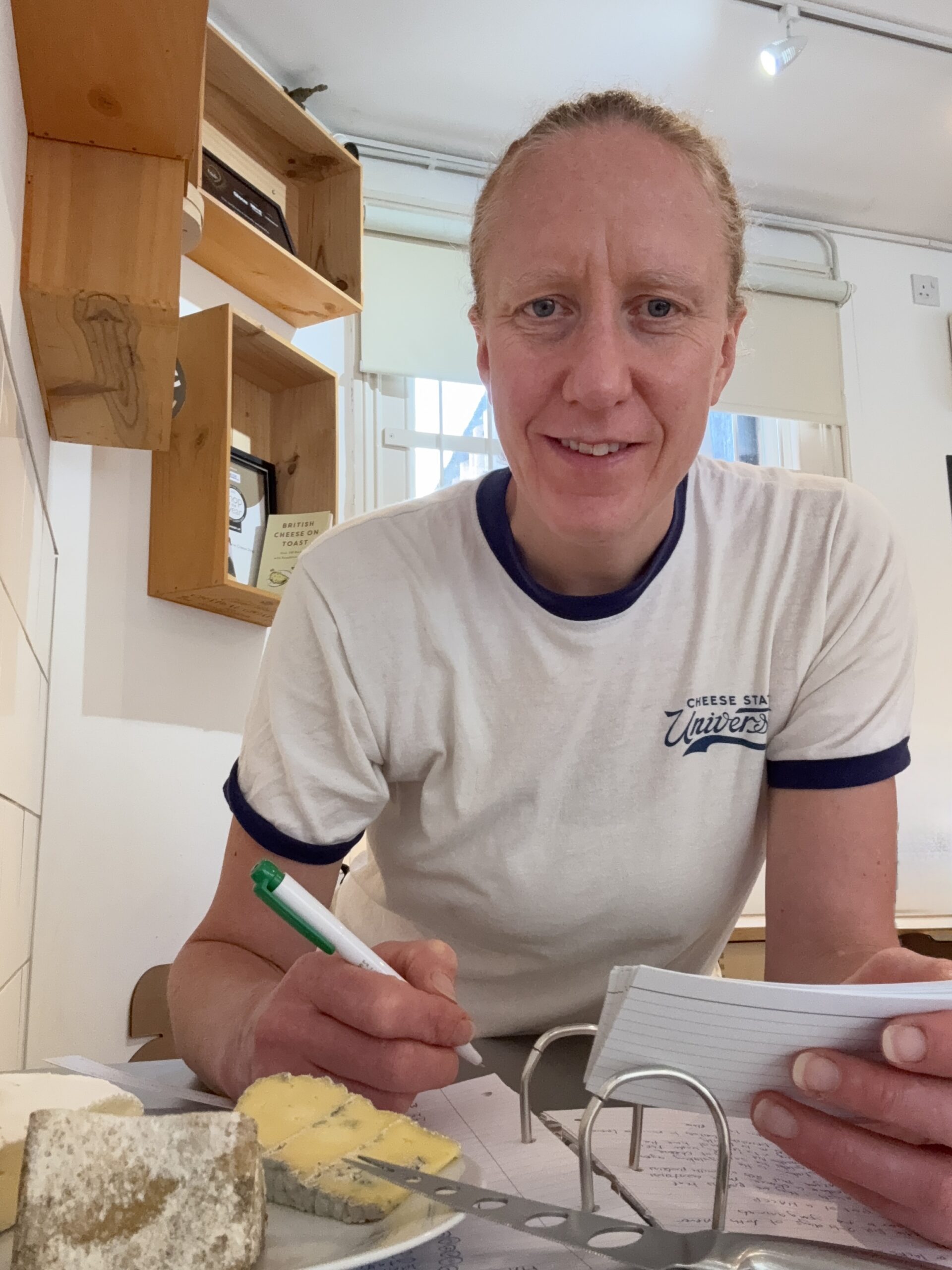
And yes, there is homework…I should probably mention that. This isn’t just an excuse to sit around eating cheese. There is proper studying involved and there are exams to pass.
But there is also cheese. Lots of cheese.
And I can’t think of many subjects where revision can legitimately involve sitting at the kitchen table with several wedges of cheese in front of you.
“Sorry, can’t do the washing up. I’m revising.”
My own Academy journey has taken me rather further than I ever imagined. What started with simply wanting to understand more about the cheeses on our counter eventually led to progressing through the Academy here in the UK, gaining professional certification in the US, judging, travelling, teaching and continuing my own studies towards Master of Cheese.
And now I get to teach Academy of Cheese courses myself. I absolutely love it. There is always a point during a course when somebody suddenly connects what we’re talking about with a cheese they’ve eaten hundreds of times.
“Ahhh… THAT’S why it does that.”
Those are my favourite moments. Because cheese stops simply being something delicious and becomes something fascinating too.
All are equally good reasons to come.
You don’t need to know your Geotrichum from your Penicillium before you walk through the door. That’s rather the point of being there. All you really need is curiosity. Well, curiosity and a willingness to eat cheese. We can help with the rest.
I sometimes think back to when we first took over the shop. I knew that I loved cheese. I knew quite a lot about eating it. I knew considerably less about everything happening inside it.
Since then, cheese has taken me into dairies, maturation rooms, classrooms and judging halls around the world. I’ve met extraordinary cheesemakers and made some wonderful friends along the way. And there is still something new to learn almost every single day.
That’s the brilliant thing about cheese.
You can enjoy it without knowing anything about it at all. But once you start asking questions… it’s very difficult to stop.
If you’ve ever stood at our counter and thought, I’d love to know more about cheese, you probably already know enough to start. The rest is what the course is for.
And yes, you do get to eat the homework.