Our Christmas orders are now closed. You can still buy our Cheese Subscriptions to start in January, as well as book our courses and tasting events. If you want to purchase vouchers you can do so until the 20th December but please note that it can take up to 48 hours for the vouchers to be emailed to you as we process these manually.
We have a full counter of cheese in our shop in Pangbourne so you can still come in and purchase items in store
Our Pangbourne shop will be closed for the day on Monday 23rd March as we’re having new display fridges installed. We’re very sorry for the inconvenience this might cause.
Welsh Wanderings
We have just returned from a lovely couple of days in Wales. We headed right over to the west coast, midway between Fishguard and Aberystwyth. I’d never been to the area before so we packed our bags and headed off. Obviously we chose to go the week after the stunning weather so we were walking in rain showers but actuallly I’d rather that than 27 degree heat! (I think Spike, our Labrador, preferred it too!)
For me the ideal day wherever we are in the world involves a run before breakfast followed by a long walk before lunch and then exploration of the area before another short walk whilst dinner is cooking. And of course the obligatory trip to somewhere cheesy! All of these were accomplished on our short break.
We spent our mornings walking parts of the Welsh Coastal path surrounding Cardigan Bay. The coastal paths were fantastically well-kept and the views across the sea were fantastic. For the most part the rain threatened but never really came to anything. Cardigan Bay is the home of Europe’s largest school of bottle nosed dolphins (which we did see!) but it is also famous for the legend of Cantre’r Gwaelod.
Cantre’r Gwaelod, sometimes called the Welsh Atlantis, is one of those stories that most people in Wales have heard at some point, often shared over a drink or two. The legend tells of a fertile kingdom where Cardigan Bay now lies. There’s no real evidence it ever existed, but that hasn’t stopped the story from becoming a lasting part of Welsh culture.
The story goes that Cantre’r Gwaelod was built on low-lying land and was a bit of a paradise for local farmers, with busy villages and fields full of crops. Building a kingdom below sea level was always going to be a bit risky, though.
Seithennin was the man in charge of keeping the sea at bay. He’s often described as someone who enjoyed a good celebration and perhaps a drink or two. One night, after a bit too much merrymaking, he forgot to close the gates, and the sea did what the sea does. The defences failed, and the kingdom disappeared under the water.
Some versions of the story also mention Mererid, who is sometimes described as a priestess or a maiden in charge of a magical well. In this telling, she accidentally lets the well overflow, which only adds to the trouble. It’s a familiar theme in Celtic stories: one small mistake, and everything changes.
When the sea finally crashed in, everyone had to make a mad dash for higher ground. When the sea finally broke through, people had to hurry to higher ground. A few managed to escape, but most of Cantre’r Gwaelod was lost beneath the water. Some say that on a calm day, you can just about see the remains of the old kingdom under Cardigan Bay. There are even stories from fishermen who claim to have heard church bells ringing from below the waves. It’s the sort of tale that sticks with you and makes for a good story to share. Archaeologists have even found ancient forests under the sea near Cardigan Bay. It’s not hard to imagine how these sights could get people spinning tales of lost kingdoms swallowed by the sea.
Even now, Cantre’r Gwaelod captures the imagination of writers, historians, and anyone who visits Wales. Whether you think it was a real place or just a good story, it shows how legends help us connect with the landscape and keep our culture going strong.
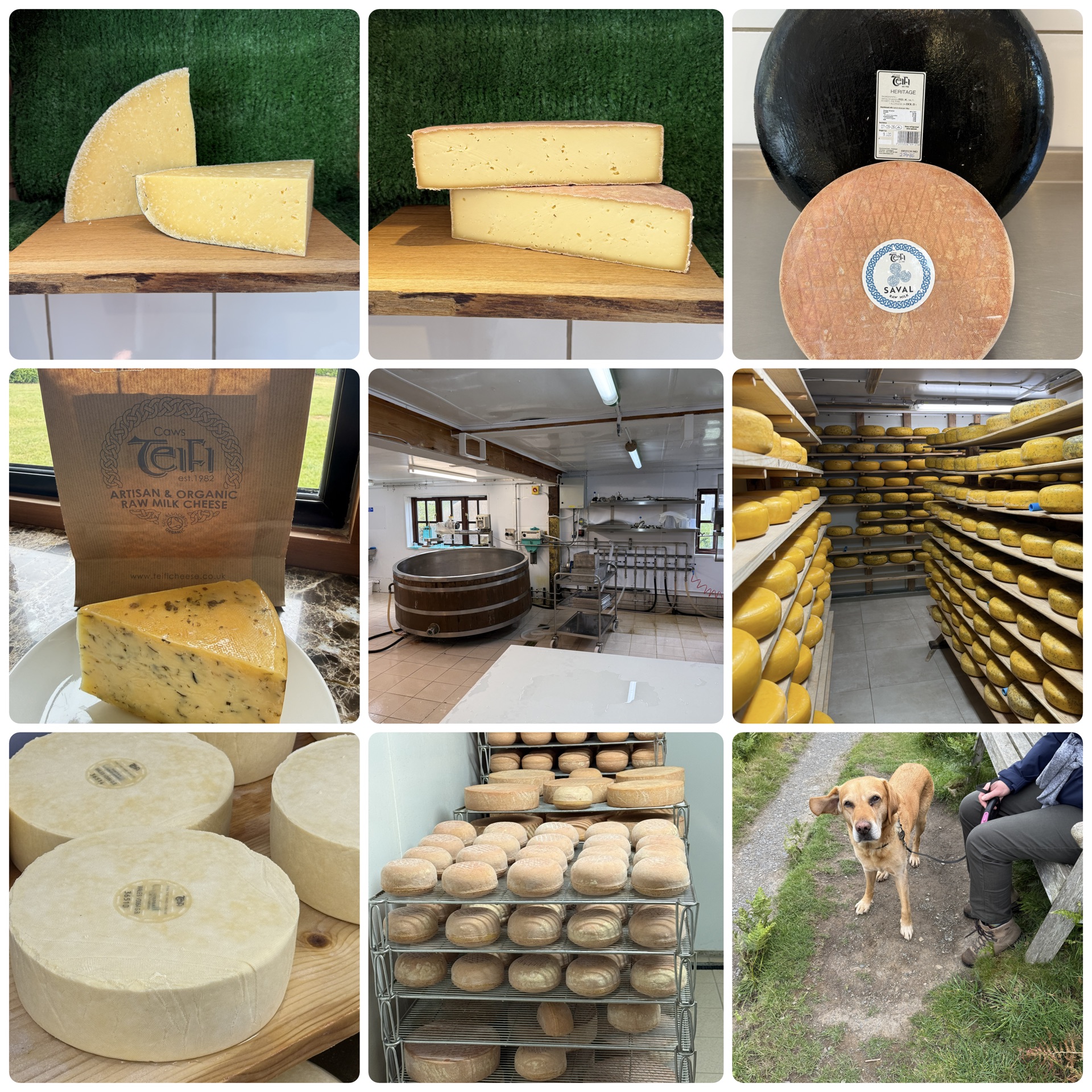
I love a good story almost as much as I love visiting cheesemakers… which leads us on nicely to the last part of our trip, a visit to Caws Teifi where the lovely Dawid gave us a tour of the dairy (and some tasters!).
Caws Teifi is Wales’s oldest established artisan cheesemaker. They are often mentioned when discussing Welsh artisan cheese. In the early 1980s, John and Patrice Savage-Onstwedder and Paula van Werkhoven left the Netherlands for Glynhynod Farm near Llandysul, Ceredigion. They aimed to enjoy a simpler life, make good cheese, and revive old traditions. By 1981, they began cheesemaking on the farm.
They had brought with them a centuries-old Dutch Gouda recipe and, by 1983–84, had made their first Teifi cheese. They used raw milk and traditional methods to preserve the full flavour often lost in large-scale production. The cheese was named after the River Teifi, which flows nearby.
At the time, farmhouse cheesemaking in Wales was rare, but Caws Teifi helped revive it. Their dedication to tradition earned national and international awards. Their cheese is still made from local, raw milk and you can taste the countryside in every bite.
We have stocked some of their cheeses before, but I am very excited to let you know that we have their Heritage Gouda and Saval cheeses in stock. The Heritage is a 2-year-old Gouda with a more open texture than its Dutch relatives, whereas Saval is a washed rind Caerphilly. Both are stunning and available in Pangbourne!
Affineur of the Year
Next Tuesday (16th) sees the return of the Affineur of the Year competition. This is a fabulous afternoon where 22 competitors (of which we are one…) showcase up to 5 different cheeses that they have been nurturing. We have had a Quickes Cheddar for nearly a year and a Gorwydd Caerphilly for a couple of months. But the really exciting thing is that you can come along and taste all of the cheeses as well as cast your vote for the best cheese. Just visit https://academyofcheese.org/product/affineur-of-the-year-finals-2026/for tickets
We use cookies on our website to give you the most relevant experience by remembering your preferences and repeat visits. By clicking “Accept All”, you consent to the use of ALL the cookies. However, you may visit "Cookie Settings" to provide a controlled consent.
This website uses cookies to improve your experience while you navigate through the website. Out of these, the cookies that are categorized as necessary are stored on your browser as they are essential for the working of basic functionalities of the website. We also use third-party cookies that help us analyze and understand how you use this website. These cookies will be stored in your browser only with your consent. You also have the option to opt-out of these cookies. But opting out of some of these cookies may affect your browsing experience.
Necessary cookies are absolutely essential for the website to function properly. These cookies ensure basic functionalities and security features of the website, anonymously.
Cookie
Duration
Description
cookielawinfo-checkbox-analytics
11 months
This cookie is set by GDPR Cookie Consent plugin. The cookie is used to store the user consent for the cookies in the category "Analytics".
cookielawinfo-checkbox-functional
11 months
The cookie is set by GDPR cookie consent to record the user consent for the cookies in the category "Functional".
cookielawinfo-checkbox-necessary
11 months
This cookie is set by GDPR Cookie Consent plugin. The cookies is used to store the user consent for the cookies in the category "Necessary".
cookielawinfo-checkbox-others
11 months
This cookie is set by GDPR Cookie Consent plugin. The cookie is used to store the user consent for the cookies in the category "Other.
cookielawinfo-checkbox-performance
11 months
This cookie is set by GDPR Cookie Consent plugin. The cookie is used to store the user consent for the cookies in the category "Performance".
viewed_cookie_policy
11 months
The cookie is set by the GDPR Cookie Consent plugin and is used to store whether or not user has consented to the use of cookies. It does not store any personal data.
Functional cookies help to perform certain functionalities like sharing the content of the website on social media platforms, collect feedbacks, and other third-party features.
Performance cookies are used to understand and analyze the key performance indexes of the website which helps in delivering a better user experience for the visitors.
Analytical cookies are used to understand how visitors interact with the website. These cookies help provide information on metrics the number of visitors, bounce rate, traffic source, etc.
Advertisement cookies are used to provide visitors with relevant ads and marketing campaigns. These cookies track visitors across websites and collect information to provide customized ads.