Our Christmas orders are now closed. You can still buy our Cheese Subscriptions to start in January, as well as book our courses and tasting events. If you want to purchase vouchers you can do so until the 20th December but please note that it can take up to 48 hours for the vouchers to be emailed to you as we process these manually.
We have a full counter of cheese in our shop in Pangbourne so you can still come in and purchase items in store
Our Pangbourne shop will be closed for the day on Monday 23rd March as we’re having new display fridges installed. We’re very sorry for the inconvenience this might cause.
A Deep Dive Into Gouda
About Gouda
Gouda is one of those cheeses that just about everyone knows, but there’s a lot more to it than its mild, buttery flavour suggests. It traditionally hails from the Netherlands, and there is so much history behind it that it is more than just a cheese style. Indeed, it has been shaped by the land, the people, and years of careful making. Its story is woven into Dutch farming and trade, and even the name itself hints at its origins and how it’s made.
Gouda has been around since at least the 12th century, which is rather impressive when you think about it. The cheese was made on farms scattered across the countryside, but it took its name from the town of Gouda in South Holland. Oddly enough, most of the cheese wasn’t actually made in the town itself; Gouda was simply the place where cheesemakers gathered to weigh, sample, and sell their wheels. Over time, the name stuck, and now Gouda means a style of cheese rather than just a place on the map.
Gouda’s story is really rooted in the Dutch landscape. The low, peaty soils in South Holland aren’t much use for growing crops, but they’re just right for cows. That meant plenty of milk, butter, and, naturally, cheese. Cheese was especially useful because it kept all the goodness of milk for much longer, perfect for trading and sending off on adventures abroad. As Dutch traders set sail across Europe in the Middle Ages and beyond, Gouda cheese went along for the ride, quietly building its reputation far and wide.
The Make
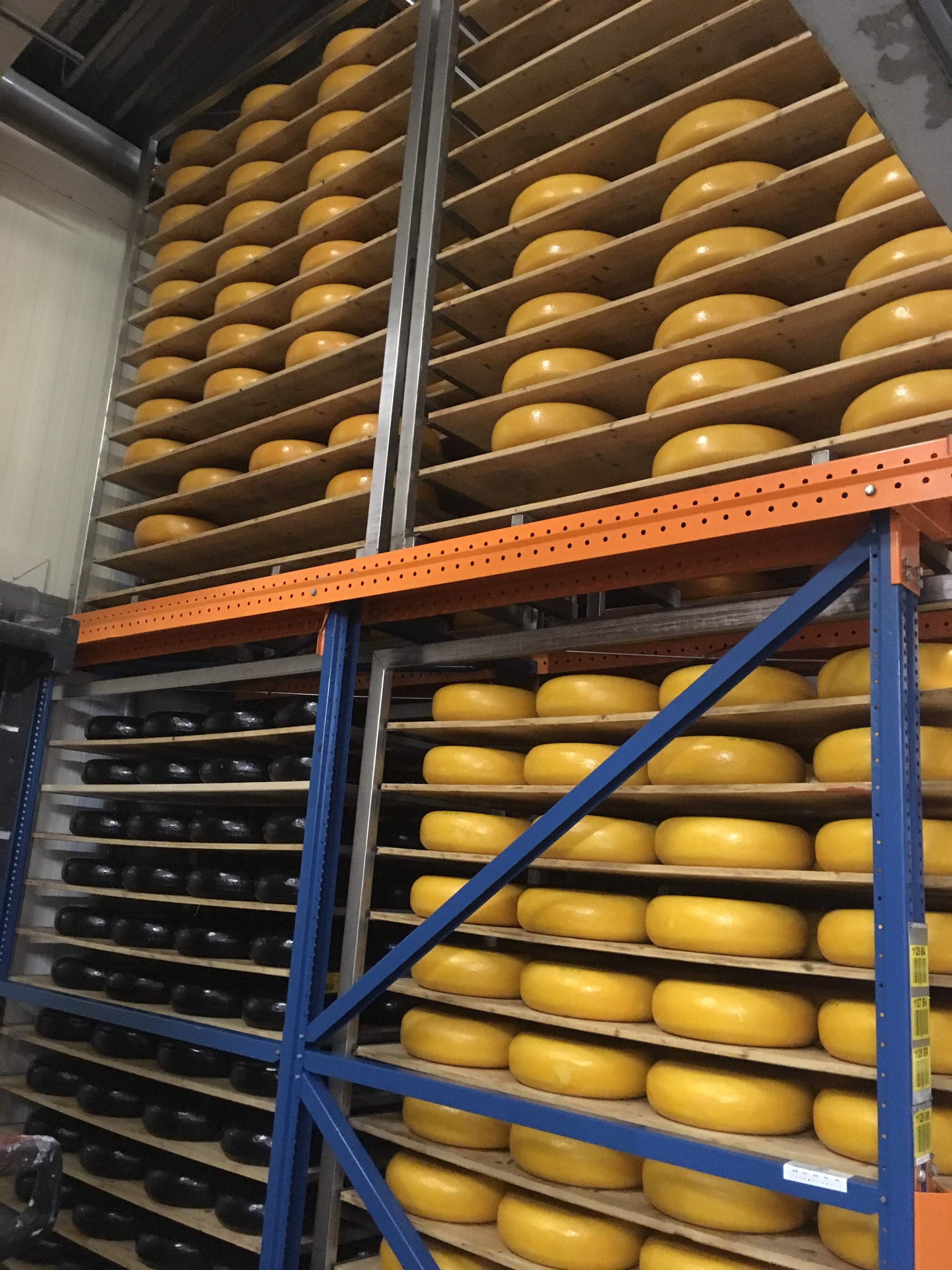
Traditional Gouda is made from cow’s milk and has its own special way of coming together. Once the curds are ready, some of the whey is drained out of the vat and warm water is added, a step called curd washing. This means there’s less lactose to be converted into lactic acid, so the cheese ends up mellow and a little bit sweet, rather than tangy. The curds are pressed into big, round wheels, brined, and then left to age for as long as you fancy.
Jen’s Taste Profiles
How long you age Gouda makes all the difference. Young Gouda, just a few weeks old, is soft, pale, and mild, with a lovely smooth texture. As it ages, it darkens, the flavours deepen (think nutty, caramel), and sometimes a hint of savoury emerges. If you’re lucky, a well-aged Gouda (such as our 4 year old Aged Gouda) will have those little crunchy crystals that cheese fans love. In the past, ageing also allowed the cheese to travel further, which helped make Gouda a big name in trade. Adding herbs and spices into Gouda is a huge Dutch tradition. Whenever we go over to Friesland (in the north of the Netherlands) to visit family I am always amazed at the variety that is available in the shops. Gouda with Cumin is massively popular with our customers and our Gouda with Truffles has a perfectly balanced blend of cheese and truffle.
Provenance
When it comes to provenance, Gouda is in an interesting spot. Unlike some European cheeses that are tightly protected by geography, the name “Gouda” has been used far and wide for ages. These days, you’ll find cheeses called Gouda made everywhere from the United States to Australia. That said, the European Union has granted special status to traditional varieties such as Noord-Hollandse Gouda PDO, Gouda Holland PGI and Boerenkaas TSG. These labels ensure that some Goudas are still made in the Netherlands, using Dutch milk and traditional methods.
The town of Gouda itself was key to ensuring the cheese was of good quality. The cheese markets had strict rules, and the official weigh houses made sure everything was fair. There’s even a famous hand-clapping ritual between buyers and sellers, which you can still see today – it’s a lovely bit of tradition that shows how much the cheese trade is grounded in community. All these things helped build trust in Gouda cheese long before there were any modern food rules.
These days, Gouda is still right at the heart of Dutch food. You’ll find it in everyday sandwiches, on special cheese boards, and being sent all over the world. There’s plenty of mass-produced Gouda out there, but the traditional farmhouse versions, called ‘boerenkaas’, are still made the old way and are packed with local character. Often made from raw milk, they give you a real taste of the land and the traditions that started it all.
Jen’s Thoughts
Gouda is much more than just a cheese that everyone enjoys. It’s shaped by its landscape, a long history of trade, and years of change. From the old markets in South Holland to cheese boards around the world today, Gouda’s real charm is in how it balances simplicity, tradition, and proper depth. It’s a good reminder of just how much where a food comes from really matters.
We use cookies on our website to give you the most relevant experience by remembering your preferences and repeat visits. By clicking “Accept All”, you consent to the use of ALL the cookies. However, you may visit "Cookie Settings" to provide a controlled consent.
This website uses cookies to improve your experience while you navigate through the website. Out of these, the cookies that are categorized as necessary are stored on your browser as they are essential for the working of basic functionalities of the website. We also use third-party cookies that help us analyze and understand how you use this website. These cookies will be stored in your browser only with your consent. You also have the option to opt-out of these cookies. But opting out of some of these cookies may affect your browsing experience.
Necessary cookies are absolutely essential for the website to function properly. These cookies ensure basic functionalities and security features of the website, anonymously.
Cookie
Duration
Description
cookielawinfo-checkbox-analytics
11 months
This cookie is set by GDPR Cookie Consent plugin. The cookie is used to store the user consent for the cookies in the category "Analytics".
cookielawinfo-checkbox-functional
11 months
The cookie is set by GDPR cookie consent to record the user consent for the cookies in the category "Functional".
cookielawinfo-checkbox-necessary
11 months
This cookie is set by GDPR Cookie Consent plugin. The cookies is used to store the user consent for the cookies in the category "Necessary".
cookielawinfo-checkbox-others
11 months
This cookie is set by GDPR Cookie Consent plugin. The cookie is used to store the user consent for the cookies in the category "Other.
cookielawinfo-checkbox-performance
11 months
This cookie is set by GDPR Cookie Consent plugin. The cookie is used to store the user consent for the cookies in the category "Performance".
viewed_cookie_policy
11 months
The cookie is set by the GDPR Cookie Consent plugin and is used to store whether or not user has consented to the use of cookies. It does not store any personal data.
Functional cookies help to perform certain functionalities like sharing the content of the website on social media platforms, collect feedbacks, and other third-party features.
Performance cookies are used to understand and analyze the key performance indexes of the website which helps in delivering a better user experience for the visitors.
Analytical cookies are used to understand how visitors interact with the website. These cookies help provide information on metrics the number of visitors, bounce rate, traffic source, etc.
Advertisement cookies are used to provide visitors with relevant ads and marketing campaigns. These cookies track visitors across websites and collect information to provide customized ads.