£5.45
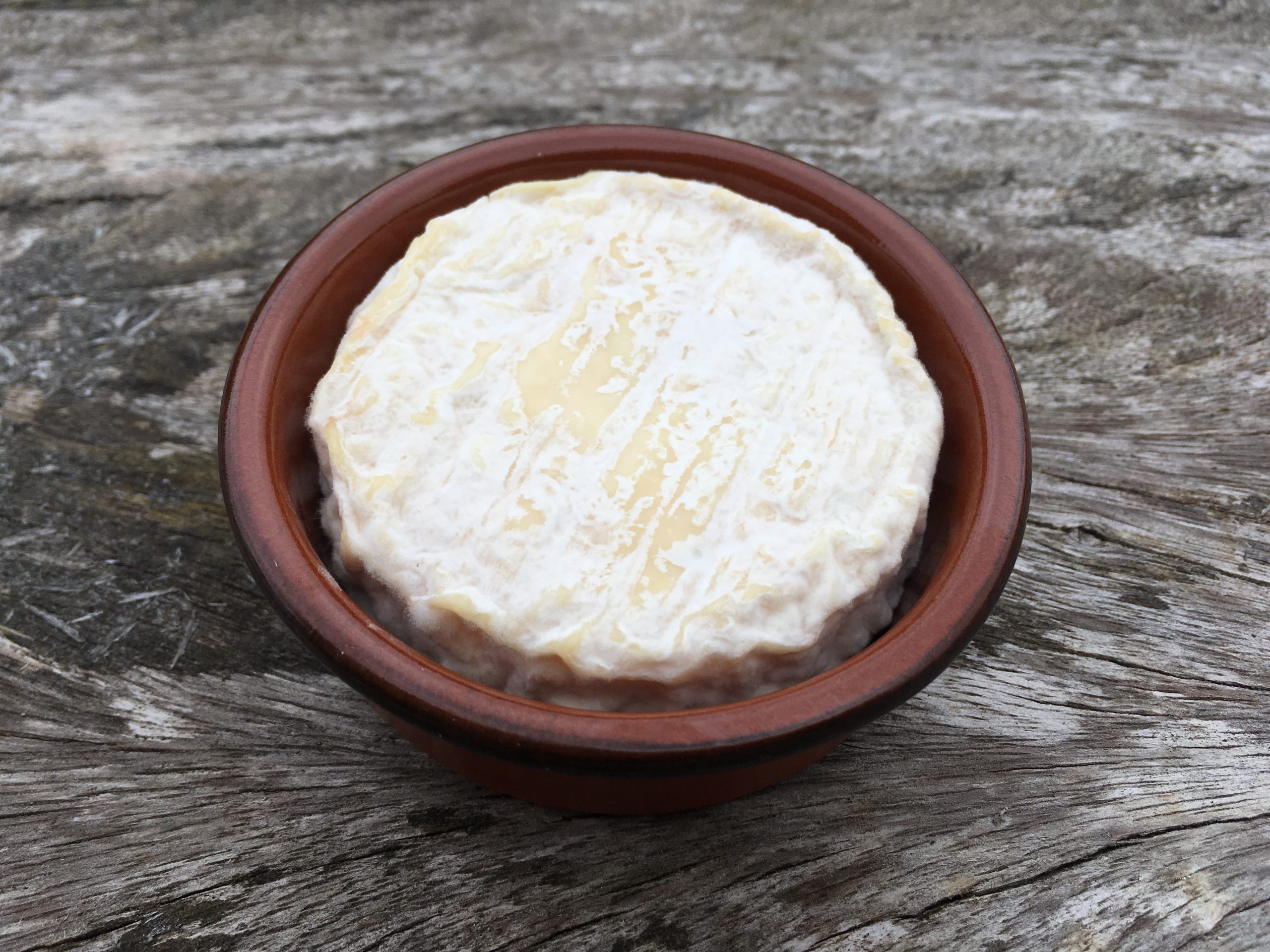
Saint-Marcellin PGI is a small French cow’s milk cheese that becomes wonderfully soft and creamy as it ripens, with buttery, nutty and gently earthy flavours.
Saint-Marcellin is a wonderful little soft cheese from the Dauphiné region of southeastern France. It might be small, but when perfectly ripe it has an incredibly creamy texture and far more flavour than its size might suggest.
Made from cow’s milk, it takes its name from the town of Saint-Marcellin in Isère and has been part of the local cheese tradition for centuries.
Today, Saint-Marcellin has Protected Geographical Indication (PGI) status, protecting its connection with the region and the traditional methods used to make it.
Saint-Marcellin has a long history, with references to the cheese stretching back centuries.
According to local legend, in 1445 the future King Louis XI was out hunting when he had a rather unfortunate encounter with a bear. Two local woodcutters came to his rescue and afterwards gave him bread and Saint-Marcellin.
Apparently Louis was so impressed by the cheese that he later introduced it to the royal table.
Did it happen exactly like that? Who knows. But unlike some of the cheese stories we’ve come across, at least this one has been attached to Saint-Marcellin for a very long time.
Originally, cheeses in this area were often made with goat’s milk or a mixture of milks. As cattle farming became more important, cow’s milk gradually took over, and today Saint-Marcellin PGI is a cow’s milk cheese.
Saint-Marcellin received PGI protection in 2013, formally recognising its connection with its traditional production area.
It’s made within a defined region centred around Isère and neighbouring parts of Drôme and Savoie. The PGI specification controls not just where the cheese is made, but aspects of the milk production, cheesemaking and maturation too.
Saint-Marcellin is a lactic-set cheese, meaning the milk coagulates slowly rather than being quickly set into a firm curd. The curd isn’t pressed, which helps explain that wonderfully delicate texture.
The little cheeses are then salted and left to mature, changing dramatically as they age.
For me, Saint-Marcellin is all about when you eat it.
When young, it’s firmer and fresher, with a gentle lactic tang and clean, milky flavours. As it ripens, the texture becomes softer and the flavours richer.
But give me a properly ripe Saint-Marcellin every time.
At that stage, the paste can become gloriously soft and almost runny, with flavours of butter and cream alongside gentle nuttiness, yeastiness and a little earthiness.
The rind is very thin and delicate and can develop white, grey or blue-grey moulds as it matures. Don’t be frightened by them — they’re part of the character of the cheese.
This is one where I’d definitely recommend trying it at different stages of maturity. A young Saint-Marcellin and a fully ripe one can feel like two completely different cheeses.
Jen’s note: Legend has it that the future Louis XI was once separated from his hunting party and found himself face-to-face with a hungry bear. Local woodsmen distracted the bear by offering it some of their cheese, saving the future king from danger. Impressed by the cheese’s quality, Louis is said to have later introduced it to his court.
Sizes and Prices
Storage Advice
Delivery and Collection
Ingredients (Allergens are listed in capitals)
MILK, starter cultures, rennet, salt
| Cookie | Duration | Description |
|---|---|---|
| cookielawinfo-checkbox-analytics | 11 months | This cookie is set by GDPR Cookie Consent plugin. The cookie is used to store the user consent for the cookies in the category "Analytics". |
| cookielawinfo-checkbox-functional | 11 months | The cookie is set by GDPR cookie consent to record the user consent for the cookies in the category "Functional". |
| cookielawinfo-checkbox-necessary | 11 months | This cookie is set by GDPR Cookie Consent plugin. The cookies is used to store the user consent for the cookies in the category "Necessary". |
| cookielawinfo-checkbox-others | 11 months | This cookie is set by GDPR Cookie Consent plugin. The cookie is used to store the user consent for the cookies in the category "Other. |
| cookielawinfo-checkbox-performance | 11 months | This cookie is set by GDPR Cookie Consent plugin. The cookie is used to store the user consent for the cookies in the category "Performance". |
| viewed_cookie_policy | 11 months | The cookie is set by the GDPR Cookie Consent plugin and is used to store whether or not user has consented to the use of cookies. It does not store any personal data. |

Normal opening Monday – Saturday 9am – 4pm until:
Sunday 22nd 9am – 4pm
Monday 23rd 9am – 4pm
Christmas Eve 9am – 12pm
Christmas Day Closed
Boxing Day Closed
Friday 27th Closed
Saturday 28th 9am – 4pm
Sunday 29th Closed
Monday 30th 9am – 2pm
Tuesday 31st 9am – 2pm
New Year’s Day Closed
Thursday 2nd January Closed
Friday 3rd 9am – 4pm then open as normal
After Christmas our courier delivery slots start from 8th January.