£12.00
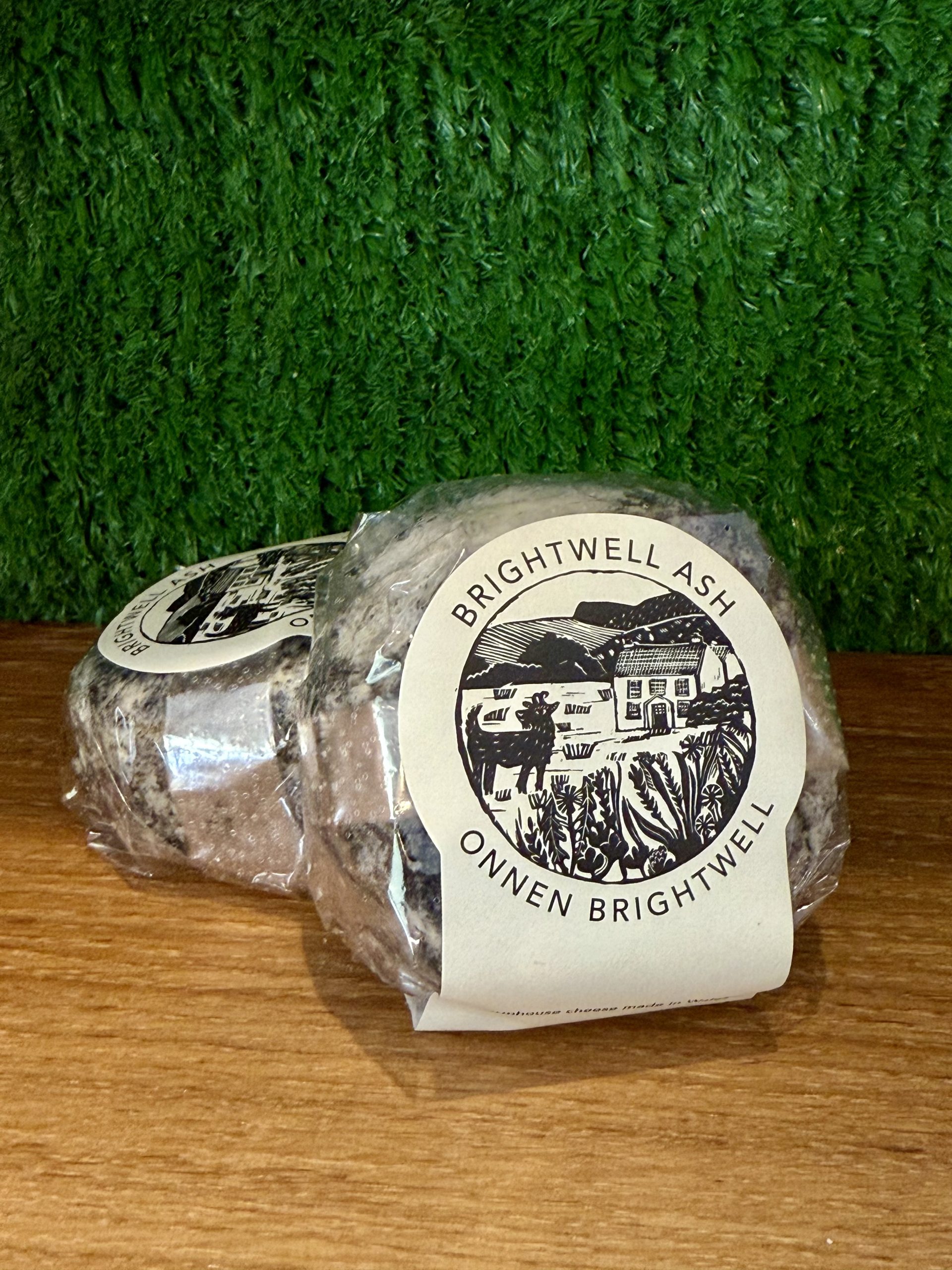
Brightwell Ash is difficult to miss. A little log of snowy-white goat’s cheese covered in a dark ash rind, it looks striking on a cheeseboard before you’ve even taken a bite.
Made by Fraser Norton and Rachel Yarrow of Norton & Yarrow Cheese, Brightwell Ash is made from the pasteurised milk of their own Anglo-Nubian goats. Underneath that dramatic rind you’ll find a beautifully silky cheese with fresh citrus flavours when young, becoming softer, nuttier and more savoury as it matures.
If you’ve already read about Sinodun Hill, you’ll know I’m a huge fan of what Fraser and Rachel do.
Brightwell Ash gives me another reason why.
This is where things get really interesting.
The dark coating on Brightwell Ash is food-grade vegetable ash, and it isn’t simply there because it looks good.
The tradition of using ash on cheese goes back centuries, particularly in French goat’s cheeses. Historically, ash was a useful way of protecting the surface of a young cheese. Today we understand rather more about what’s happening: the ash helps alter the conditions on the surface of the cheese, reducing acidity and encouraging the rind to develop.
And yes, you eat it.
As Brightwell matures, that dramatic black coating gradually becomes covered by the developing rind, so a young cheese can look quite different from a more mature one.
It’s one of those lovely bits of cheesemaking where something that looks decorative is actually part of how the cheese develops.
Brightwell Ash takes its name from Brightwell-cum-Sotwell in Oxfordshire, close to Earth Trust Farm where Fraser and Rachel first established Norton & Yarrow Cheese.
In January 2025, they moved their entire cheesemaking operation — including their goats and even their dairy buildings — to their own farm near Llangadog in Carmarthenshire.
The cheese may now be made in Wales, but its name keeps that connection to the place where it began.
There’s also a lovely Welsh addition to the story. Onnen means ash tree in Welsh, so the name Onnen Brightwell brings together the cheese’s past, its new home and, rather neatly, its distinctive ash-covered rind.
Cut into a young Brightwell Ash and the contrast is gorgeous: that dark rind surrounding an almost snowy-white centre.
The texture is silky and smooth, with a lovely freshness to it. The first flavours I notice are citrus and a clean, bright acidity, followed by the natural sweetness and richness of the goat’s milk.
But don’t just eat the middle.
The rind is an important part of Brightwell Ash, so make sure you taste the whole cheese together. The ash itself isn’t there to give you a great wallop of flavour; instead, it’s part of the rind development and that rind brings another layer of earthiness and savouriness to the fresh cheese underneath.
As Brightwell matures, the paste immediately beneath the rind begins to soften while the centre can remain slightly firmer. The fresh citrus flavours become rounder and I start to find gentle hazelnut and savoury notes coming through.
I love tasting Brightwell at different stages because it really does demonstrate how much a cheese can change in a relatively short space of time.
If you get the opportunity, buy one young and another slightly more mature and taste them side by side. That’s my kind of experiment.
Jen’s note: The ash on Brightwell isn’t just there to make it look pretty. It helps create the right conditions for the rind to develop — and watching that rind change as the cheese matures is fascinating. It’s another reminder that cheese isn’t a finished product the moment the cheesemaker makes it; it continues to change right up until the moment we eat it.
Sizes and Prices
Storage Advice
Delivery and Collection
Ingredients (Allergens are listed in capitals)
MILK, salt, starter cultures, vegetarian rennet, vegetable ash, ripening cultures.
| Cookie | Duration | Description |
|---|---|---|
| cookielawinfo-checkbox-analytics | 11 months | This cookie is set by GDPR Cookie Consent plugin. The cookie is used to store the user consent for the cookies in the category "Analytics". |
| cookielawinfo-checkbox-functional | 11 months | The cookie is set by GDPR cookie consent to record the user consent for the cookies in the category "Functional". |
| cookielawinfo-checkbox-necessary | 11 months | This cookie is set by GDPR Cookie Consent plugin. The cookies is used to store the user consent for the cookies in the category "Necessary". |
| cookielawinfo-checkbox-others | 11 months | This cookie is set by GDPR Cookie Consent plugin. The cookie is used to store the user consent for the cookies in the category "Other. |
| cookielawinfo-checkbox-performance | 11 months | This cookie is set by GDPR Cookie Consent plugin. The cookie is used to store the user consent for the cookies in the category "Performance". |
| viewed_cookie_policy | 11 months | The cookie is set by the GDPR Cookie Consent plugin and is used to store whether or not user has consented to the use of cookies. It does not store any personal data. |

Normal opening Monday – Saturday 9am – 4pm until:
Sunday 22nd 9am – 4pm
Monday 23rd 9am – 4pm
Christmas Eve 9am – 12pm
Christmas Day Closed
Boxing Day Closed
Friday 27th Closed
Saturday 28th 9am – 4pm
Sunday 29th Closed
Monday 30th 9am – 2pm
Tuesday 31st 9am – 2pm
New Year’s Day Closed
Thursday 2nd January Closed
Friday 3rd 9am – 4pm then open as normal
After Christmas our courier delivery slots start from 8th January.