• 0118 984 3323
Cheese-Etc Pangbourne Reading
  • My Account
£0.00 0 Basket
  • Buy Cheese
    • All
    • Cheddar
    • Hard
    • Soft
    • Blue
    • Goat
    • Sheep
    • Smoked
    • Smelly
    • Flavoured
  • Etc.
    • Crackers
    • Chutneys
  • Selections
  • Gifts
    • Cheese Gift Boxes
    • Cheese Gift Vouchers
    • Mouseware
    • Subscriptions
  • Towers
  • Tasting Events
  • Courses
  • Buy Cheese
    • All
    • Cheddar
    • Hard
    • Soft
    • Blue
    • Goat
    • Sheep
    • Smoked
    • Smelly
    • Flavoured
  • Etc.
    • Crackers
    • Chutneys
  • Selections
  • Gifts
    • Cheese Gift Boxes
    • Cheese Gift Vouchers
    • Mouseware
    • Subscriptions
  • Towers
  • Tasting Events
  • Courses
  • Account
£0.00 0 Basket

Our Christmas orders are now closed. You can still buy our Cheese Subscriptions to start in January, as well as book our courses and tasting events. If you want to purchase vouchers you can do so until the 20th December but please note that it can take up to 48 hours for the vouchers to be emailed to you as we process these manually.

We have a full counter of cheese in our shop in Pangbourne so you can still come in and purchase items in store

  • Buy Cheese
    • All
    • Cheddar
    • Hard
    • Soft
    • Blue
    • Goat
    • Sheep
    • Smoked
    • Smelly
    • Flavoured
  • Etc.
    • Crackers
    • Chutneys
  • Selections
  • Gifts
    • Cheese Gift Boxes
    • Cheese Gift Vouchers
    • Mouseware
    • Subscriptions
  • Towers
  • Tasting Events
  • Courses
  • Buy Cheese
    • All
    • Cheddar
    • Hard
    • Soft
    • Blue
    • Goat
    • Sheep
    • Smoked
    • Smelly
    • Flavoured
  • Etc.
    • Crackers
    • Chutneys
  • Selections
  • Gifts
    • Cheese Gift Boxes
    • Cheese Gift Vouchers
    • Mouseware
    • Subscriptions
  • Towers
  • Tasting Events
  • Courses

Have you ever come across those crunchy little bits in cheese?

They’re actually crystals, and far from being a problem, they’re a lovely sign that the cheese has been aged and is packed with flavour.

The main culprits

  • Tyrosine crystals
    Tyrosine crystals are the ones you’ll spot most often. Tyrosine is an amino acid that shows up as the proteins in cheese gently break down during ageing. As time goes by, it forms those tiny white flecks that give a satisfying crunch when you bite in. You’ll find them in the likes of Parmigiano-Reggiano PDO, aged Gouda, Comté PDO, and Grana Padano PDO – all the big hitters.
  • Calcium lactate crystals
    Calcium lactate crystals are a little less common, but they do like to pop up in aged cheddars. Sometimes you’ll find them tucked inside the cheese, other times they appear on the surface. The crunch is a bit different from tyrosine – but still very pleasing.

Why they form

As cheese matures, two main things are going on: the proteins and sugars are quietly breaking down.

  • The cheese also slowly loses moisture, and as this happens, some of the compounds inside become less able to stay dissolved.
  • Before you know it, those crystals start to appear.

It’s really just the cheese’s way of showing off that it’s reached a new level.

You might wonder: are these crunchy crystals safe to eat?

Absolutely! They’re not mould, not salt, and certainly not a defect. In fact, many cheesemakers are delighted to see them, as they’re a sign of long ageing and deep, developed flavour.

Flavour bonus

Those crunchy bits usually bring a few bonuses with them:

  • Intense umami
  • Brothy, savoury notes
  • That moment when you think, ‘this cheese really means business.’

What tyrosine actually is

Tyrosine is an amino acid, one of the building blocks of proteins. In milk, proteins (mainly casein) are long, tightly folded chains. Fresh cheese keeps those chains mostly intact.

But in aged cheese, those protein chains don’t hang around for long.

How tyrosine forms in cheese

During aging, three big things are happening:

  1. Proteolysis (protein breakdown)
    • Enzymes from rennet, starter bacteria, and other microbes get to work breaking down those long casein chains into smaller pieces. These are then broken down even further into individual amino acids.
  2. This is when tyrosine is released and begins to accumulate
    • Tyrosine is released in relatively high amounts compared to other amino acids.
  3. Crystallisation
    • Tyrosine doesn’t dissolve very well in water. As cheese ages, it loses moisture, becomes denser, and can even develop little pockets with a higher pH.

When there’s more tyrosine than the remaining moisture can cope with, it starts to settle out as crystals. That lovely crunch is actually just a solid form of an amino acid.

Why tyrosine crystallises (and others don’t)

Not all amino acids act like this. Tyrosine is a bit special because:

  • It has an aromatic ring (bulky structure)
  • It’s less water-soluble.
  • It tends to stack up and line up, which is what gives you those visible crystals.

Other amino acids usually remain dissolved and contribute to flavour rather than texture.

What tyrosine crystals tell you

You can think of them as a little progress report from the cheese:

  • Long aging (often 18+ months)
  • Slow, controlled proteolysis
  • Low moisture
  • High-quality milk and make

That’s why you’ll spot them in traditionally made, hard cheeses, and not so much in the quick-aged, industrial sorts.

Texture & flavour impact

  • Texture-wise, they give a sharp, brittle crunch – some people even call it ‘glass-like’.
  • The flavour on its own is usually neutral or just a touch bitter, but the crystals tend to arrive with:
    • intense umami
    • brothy, umami notes
    • nutty aromas

The crystals aren’t what make the flavour, they’re just a sign that all the flavour-making chemistry has been hard at work.

Fun cheese-nerd detail

Under a microscope, tyrosine crystals look like:

  • needles
  • stars
  • jagged shards

What Calcium Lactate Is

  • Chemical formula: C6H10CaO6
  • It’s a calcium salt of lactic acid, which is produced during cheese fermentation when starter bacteria metabolise lactose.
  • Essentially, it’s the cheese’s way of turning ‘calcium plus leftover lactic acid’ into little crystals.

How Calcium Lactate Forms in Cheese

  1. Lactic acid production
    Starter bacteria in the cheese convert lactose (milk sugar) into lactic acid.
  2. Calcium interaction
    Milk contains calcium naturally. Lactic acid can combine with calcium to form calcium lactate.
  3. Supersaturation → crystallisation
    If the local concentration of calcium lactate exceeds how much can dissolve in the remaining moisture:
    • Crystals form
    • Often near the surface or along cracks, not as deep inside as tyrosine
  4. Environmental factors
    • pH: more likely if the cheese is slightly more acidic
    • Moisture: lower moisture favours crystallisation
    • Temperature: can form during aging or even after packaging

Where You Find Calcium Lactate Crystals

  • Aged Cheddar
  • You might spot them on the surface or tucked into the cracks of a block.
  • Less common in long-aged hard European cheeses (like Parmigiano) because those favour tyrosine instead

Texture & Taste

  • The crunch is softer, more of a ‘pop’ than the brittle snap you get from tyrosine.
  • The mouthfeel can be a little chalky, almost sugary.
  • The taste is mostly neutral, though you might notice a faint mineral note.
  • Often mistaken for tyrosine if you’re not careful, but the crunch and chalkiness give it away.

Fun cheese-nerd detail

  • Calcium lactate crystals are sometimes visible as white or slightly translucent deposits.
  • They can appear even on young cheeses if storage conditions favour supersaturation.
  • Some cheesemakers even try to control crystallisation to avoid surface crystals in mild Cheddar, as some people still see them as a fault.

It’s amazing how much science goes into cheese, isn’t it?
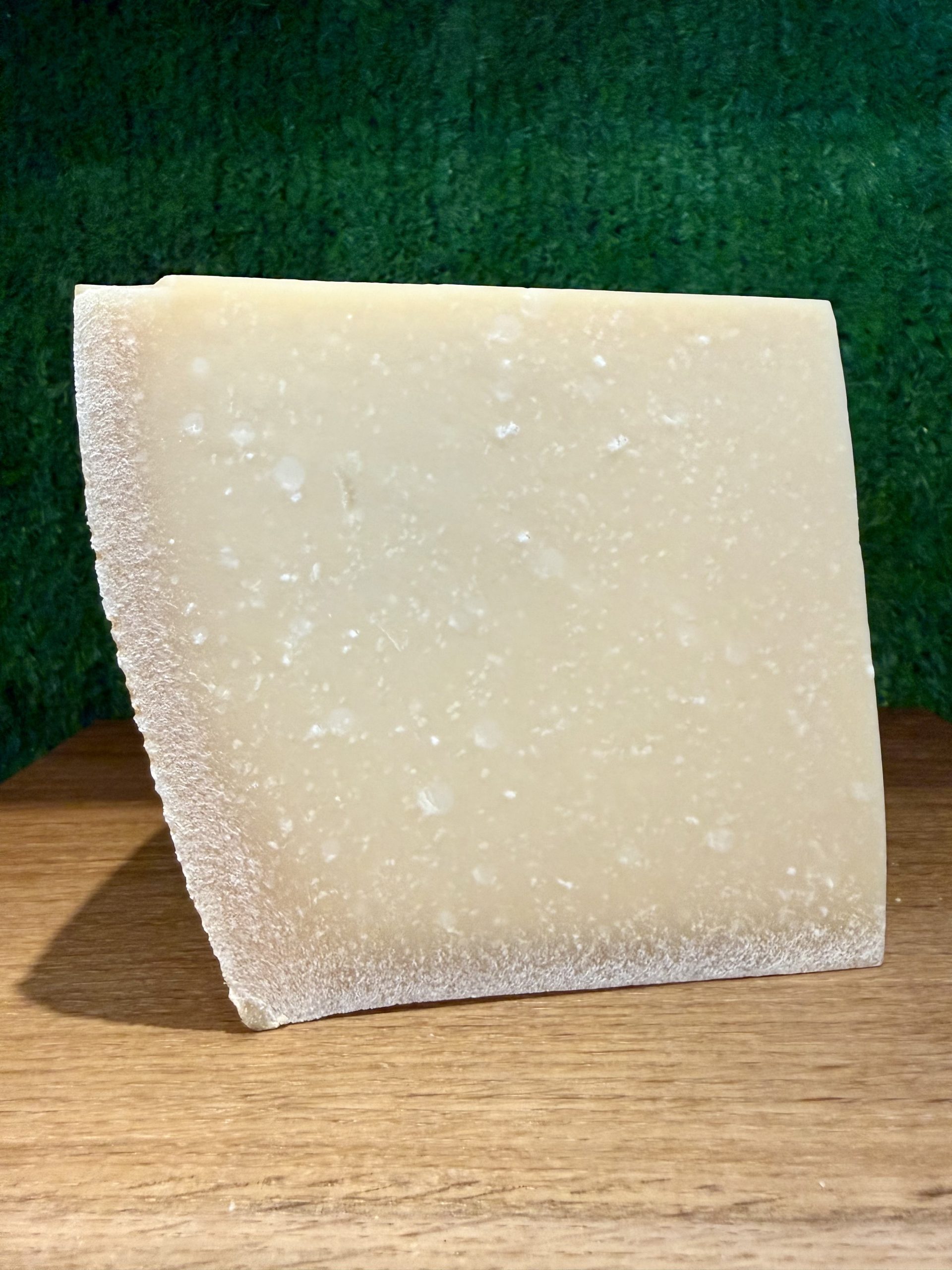
A wedge of freshly cut Parmigiano-Reggiano PDO

Have you ever come across those crunchy little bits in cheese?

Have you ever come across those crunchy little bits in cheese?

  • February 2, 2026
  • 1:25 pm
Previous December 2025
RSS Cheese Etc. The Pangbourne Cheese Shop Reading
  • Have you ever come across those crunchy little bits in cheese?
  • December 2025
  • World Cheese Awards, Bern 2025
  • South Africa 2025
  • Lumpy Skin Disease
  • Tales Of American Cheese
  • Affineur of the Year
  • Shropshire Wanderings
  • March 2025
  • February 2025
Archives

FREE Local Delivery!

* terms and conditions apply

Cheese-Etc Pangbourne Reading
  • Cheese Shop
  • About Us
  • News
  • FAQs
  • Delivery
  • Repeat Orders
  • Caring for your Cheese
  • Access to Cheese Etc
  • Terms & Conditions
  • Privacy Policy
  • Contact Us
  • Cheese Shop
  • About Us
  • News
  • FAQs
  • Delivery
  • Repeat Orders
  • Caring for your Cheese
  • Access to Cheese Etc
  • Terms & Conditions
  • Privacy Policy
  • Contact Us

News

Have you ever come across those crunchy little bits in cheese?

2nd February 2026

They’re actually crystals, and far from being a problem, they’re a lovely sign that the cheese has been aged and is packed with flavour. The

Read More »

December 2025

4th December 2025

At this time of year the most common question I get asked is “what makes it onto your Christmas cheeseboard?” The truth is that our

Read More »
  • The Running Cheesemonger Blog
  • Cheese Recipes

Weekly Newsletter

shop of the year award 2020
shop of the year award 2019
farm shop and deli award reading
farm shop and deli award pangbourne
farm shop and deli award berkshire
shop of the year award 2018
world cheese award
guild of fine food
Specialist cheese makers association
Our Cheese Etc Roundel and Cheese Etc logo style are both registered trademarks ©2026 Cheese Etc.

Website designers Reading

Facebook-f Twitter Instagram
We use cookies on our website to give you the most relevant experience by remembering your preferences and repeat visits. By clicking “Accept All”, you consent to the use of ALL the cookies. However, you may visit "Cookie Settings" to provide a controlled consent.
Cookie SettingsAccept All
Manage consent

Privacy Overview

This website uses cookies to improve your experience while you navigate through the website. Out of these, the cookies that are categorized as necessary are stored on your browser as they are essential for the working of basic functionalities of the website. We also use third-party cookies that help us analyze and understand how you use this website. These cookies will be stored in your browser only with your consent. You also have the option to opt-out of these cookies. But opting out of some of these cookies may affect your browsing experience.
Necessary
Always Enabled
Necessary cookies are absolutely essential for the website to function properly. These cookies ensure basic functionalities and security features of the website, anonymously.
CookieDurationDescription
cookielawinfo-checkbox-analytics11 monthsThis cookie is set by GDPR Cookie Consent plugin. The cookie is used to store the user consent for the cookies in the category "Analytics".
cookielawinfo-checkbox-functional11 monthsThe cookie is set by GDPR cookie consent to record the user consent for the cookies in the category "Functional".
cookielawinfo-checkbox-necessary11 monthsThis cookie is set by GDPR Cookie Consent plugin. The cookies is used to store the user consent for the cookies in the category "Necessary".
cookielawinfo-checkbox-others11 monthsThis cookie is set by GDPR Cookie Consent plugin. The cookie is used to store the user consent for the cookies in the category "Other.
cookielawinfo-checkbox-performance11 monthsThis cookie is set by GDPR Cookie Consent plugin. The cookie is used to store the user consent for the cookies in the category "Performance".
viewed_cookie_policy11 monthsThe cookie is set by the GDPR Cookie Consent plugin and is used to store whether or not user has consented to the use of cookies. It does not store any personal data.
Functional
Functional cookies help to perform certain functionalities like sharing the content of the website on social media platforms, collect feedbacks, and other third-party features.
Performance
Performance cookies are used to understand and analyze the key performance indexes of the website which helps in delivering a better user experience for the visitors.
Analytics
Analytical cookies are used to understand how visitors interact with the website. These cookies help provide information on metrics the number of visitors, bounce rate, traffic source, etc.
Advertisement
Advertisement cookies are used to provide visitors with relevant ads and marketing campaigns. These cookies track visitors across websites and collect information to provide customized ads.
Others
Other uncategorized cookies are those that are being analyzed and have not been classified into a category as yet.
SAVE & ACCEPT
christmas cheese subscriptions holly

Christmas Opening Hours

Normal opening Monday – Saturday 9am – 4pm until:

Sunday 22nd 9am – 4pm
Monday 23rd 9am – 4pm
Christmas Eve 9am – 12pm
Christmas Day Closed
Boxing Day Closed
Friday 27th Closed

Saturday 28th 9am – 4pm
Sunday 29th Closed
Monday 30th 9am – 2pm
Tuesday 31st 9am – 2pm
New Year’s Day Closed
Thursday 2nd January Closed

Friday 3rd 9am – 4pm then open as normal

After Christmas our courier delivery slots start from 8th January.