£6.00 – £36.00Price range: £6.00 through £36.00
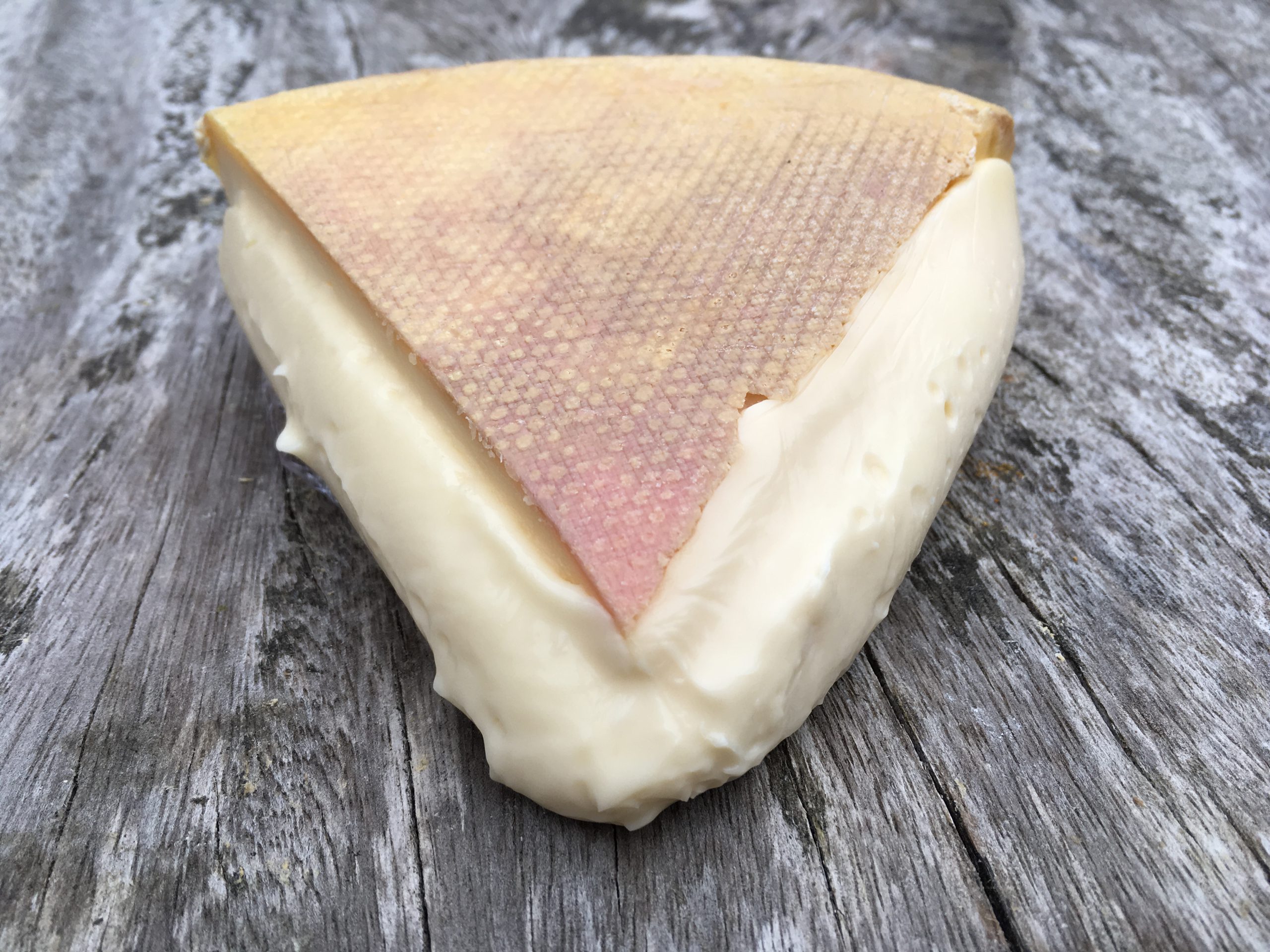
A famously pungent British washed-rind cheese with a wonderfully soft, creamy centre. Rich, savoury and far gentler in flavour than its extraordinary aroma suggests.
There are cheeses that smell.
And then there’s Stinking Bishop.
This wonderfully whiffy British cheese is one of the most famous washed-rind cheeses we sell. Customers quite often smell it before they find it in the counter — but underneath that gloriously pungent rind is a surprisingly gentle, creamy cheese.
Stinking Bishop was created in Gloucestershire in the 1990s by cheesemaker Charles Martell. It’s made using cow’s milk and washed during maturation with perry made from the local Stinking Bishop pear.
And that’s where things start to get interesting.
Despite what you might reasonably assume, Stinking Bishop isn’t named after the smell of the cheese.
It’s named after the Stinking Bishop pear used to make the perry that washes the rind.
And that pear is said to have been named after Frederick Bishop, a wonderfully bad-tempered 19th-century Gloucestershire farmer and breeder who earned the nickname ‘Stinking Bishop’.
More about him in a minute…
Washing the cheese in perry encourages the bacteria that give Stinking Bishop its distinctive sticky orange rind and famously powerful aroma. It’s a traditional technique more commonly associated with continental cheeses, and Charles Martell helped bring this style of cheesemaking back into the British spotlight.
The result is one of those wonderful cheeses where the smell and the flavour tell completely different stories.
And if Stinking Bishop looks vaguely familiar, there’s a reason for that. It famously appeared in Wallace & Gromit: The Curse of the Were-Rabbit, where its aroma was powerful enough to revive Wallace from unconsciousness.
I’m not suggesting you try this at home.
We often describe the smell of Stinking Bishop as teenagers’ trainers.
I appreciate that’s not necessarily the greatest sales pitch I’ve ever made, but bear with me.
Most of that famous aroma comes from the sticky, orange-pink rind. Cut through it and you’ll find a beautifully soft, pale yellow cheese that’s much gentler than your nose has led you to believe.
When perfectly ripe, the texture becomes wonderfully soft and creamy, almost spoonable towards the rind. The flavour is rich and savoury, with buttery, earthy and slightly nutty notes and a gentle fruity sweetness from the perry washing.
As it matures, the texture becomes softer and the flavours deepen, but it never tastes quite as terrifying as it smells.
That’s really the joy of Stinking Bishop. Your nose says run. Your tastebuds say have another piece.
Jen’s note: This is one of my favourite cheese stories. The Stinking Bishop pear is said to have been named after Frederick Bishop, a 19th-century Gloucestershire farmer with a spectacular temper. Legend has it that he once became so furious with a kettle for taking too long to boil that he SHOT IT. I have absolutely no idea whether that’s true, but frankly I don’t want anyone to prove otherwise. Some cheese stories are simply too good to investigate too closely.
Sizes and Prices
Storage Advice
Delivery and Collection
Ingredients (Allergens are listed in capitals)
MILK, salt, starter cultures, vegetarian rennet, preservative (natamycin E235), pear cider, red smear culture
| Cookie | Duration | Description |
|---|---|---|
| cookielawinfo-checkbox-analytics | 11 months | This cookie is set by GDPR Cookie Consent plugin. The cookie is used to store the user consent for the cookies in the category "Analytics". |
| cookielawinfo-checkbox-functional | 11 months | The cookie is set by GDPR cookie consent to record the user consent for the cookies in the category "Functional". |
| cookielawinfo-checkbox-necessary | 11 months | This cookie is set by GDPR Cookie Consent plugin. The cookies is used to store the user consent for the cookies in the category "Necessary". |
| cookielawinfo-checkbox-others | 11 months | This cookie is set by GDPR Cookie Consent plugin. The cookie is used to store the user consent for the cookies in the category "Other. |
| cookielawinfo-checkbox-performance | 11 months | This cookie is set by GDPR Cookie Consent plugin. The cookie is used to store the user consent for the cookies in the category "Performance". |
| viewed_cookie_policy | 11 months | The cookie is set by the GDPR Cookie Consent plugin and is used to store whether or not user has consented to the use of cookies. It does not store any personal data. |
Normal opening Monday – Saturday 9am – 4pm until:
Sunday 22nd 9am – 4pm
Monday 23rd 9am – 4pm
Christmas Eve 9am – 12pm
Christmas Day Closed
Boxing Day Closed
Friday 27th Closed
Saturday 28th 9am – 4pm
Sunday 29th Closed
Monday 30th 9am – 2pm
Tuesday 31st 9am – 2pm
New Year’s Day Closed
Thursday 2nd January Closed
Friday 3rd 9am – 4pm then open as normal
After Christmas our courier delivery slots start from 8th January.