£3.40 – £20.40Price range: £3.40 through £20.40
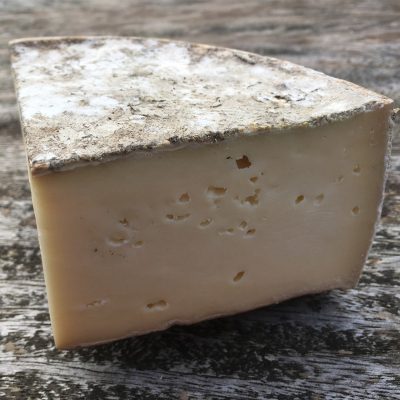
Tomme de Savoie PGI is a traditional French Alpine cheese with a rustic mottled rind, supple texture and gentle flavours of cream, hazelnut, mushroom and mountain herbs.
Due to an outbreak of Lumpy Skin Disease in France this cheese is currently unavailable. You can read more about this here
BUT we have sourced a thermised Tomme des Alpes which is made in the same region as the Tomme de Savoie PDO. You can order it here
Tomme de Savoie is one of those wonderfully rustic French cheeses that looks as though it belongs on a wooden table somewhere halfway up a mountain.
Made in the Savoie region of the French Alps, it has a mottled grey-brown rind, a supple centre and a gentle, earthy flavour. It doesn’t shout for attention in the way some of France’s more famous cheeses do, but that’s rather the point.
This was traditionally an everyday cheese, made by farming families from the milk they had available, and I think that’s a big part of its charm.
The word tomme is used for a whole family of cheeses, particularly across the French Alps, rather than describing one particular recipe.
Tomme de Savoie has its roots in the practical world of Alpine farming. Traditionally, cream was taken from the milk to make butter, and the remaining milk was turned into cheese. Nothing went to waste.
Because individual farms didn’t necessarily have huge quantities of milk available, Tommes were made in relatively small wheels — quite different from enormous mountain cheeses such as Comté or Beaufort, which required the milk from several herds.
The resulting cheese was made to be eaten rather than traded as some great luxury. It was everyday food for the people who lived and worked in the mountains.
And hundreds of years later, that’s still rather how Tomme de Savoie feels to me: unfussy, satisfying and completely at home with a chunk of bread.
Tomme de Savoie is protected by PGI status, recognising its connection with the Savoie region and the traditional knowledge behind its production.
The milk comes from the defined geographical area surrounding Savoie and Haute-Savoie, and the cheese is matured for at least several weeks while its characteristic rind develops.
And what a rind it is.
Grey, brown, sometimes slightly yellow and covered with natural moulds, it can look rather alarming if you’re expecting cheese to have a perfectly neat white coat.
But that’s exactly how Tomme de Savoie is supposed to look. Its wonderfully rustic rind is part of the cheese’s character and helps develop those earthy flavours as it matures.
Tomme de Savoie isn’t the prettiest cheese on the counter — although I think its slightly scruffy appearance is part of its appeal.
Cut through that mottled rind and you’ll find a pale straw-coloured paste, sometimes with a scattering of small holes. The texture is supple and slightly springy rather than hard, becoming softer and more yielding as the cheese matures.
The aroma is gently earthy and milky with a little mushroominess from the rind.
Flavour-wise, it’s much gentler than its appearance might suggest. I get creamy, grassy flavours first, followed by hazelnuts, mushrooms and a lovely hint of Alpine herbs. There’s sometimes a little fruitiness towards the end too.
It’s not a big, powerful mountain cheese. Instead, everything is beautifully balanced and incredibly easy to eat.
I suspect that’s exactly why people in Savoie have been eating it for generations.
Jen’s note: I love the fact that Tomme de Savoie started life as a practical cheese. Take the cream for butter, turn what remains into cheese and waste absolutely nothing. Hundreds of years later, we might give it a fancy PGI label and put it on beautiful cheeseboards, but underneath it all, it’s still a farmer’s cheese made from the very sensible idea of using what you’ve got.
Sizes and Prices
Storage Advice
Delivery and Collection
Ingredients (Allergens are listed in capitals)
MILK, salt, starter cultures, rennet
| Cookie | Duration | Description |
|---|---|---|
| cookielawinfo-checkbox-analytics | 11 months | This cookie is set by GDPR Cookie Consent plugin. The cookie is used to store the user consent for the cookies in the category "Analytics". |
| cookielawinfo-checkbox-functional | 11 months | The cookie is set by GDPR cookie consent to record the user consent for the cookies in the category "Functional". |
| cookielawinfo-checkbox-necessary | 11 months | This cookie is set by GDPR Cookie Consent plugin. The cookies is used to store the user consent for the cookies in the category "Necessary". |
| cookielawinfo-checkbox-others | 11 months | This cookie is set by GDPR Cookie Consent plugin. The cookie is used to store the user consent for the cookies in the category "Other. |
| cookielawinfo-checkbox-performance | 11 months | This cookie is set by GDPR Cookie Consent plugin. The cookie is used to store the user consent for the cookies in the category "Performance". |
| viewed_cookie_policy | 11 months | The cookie is set by the GDPR Cookie Consent plugin and is used to store whether or not user has consented to the use of cookies. It does not store any personal data. |

Normal opening Monday – Saturday 9am – 4pm until:
Sunday 22nd 9am – 4pm
Monday 23rd 9am – 4pm
Christmas Eve 9am – 12pm
Christmas Day Closed
Boxing Day Closed
Friday 27th Closed
Saturday 28th 9am – 4pm
Sunday 29th Closed
Monday 30th 9am – 2pm
Tuesday 31st 9am – 2pm
New Year’s Day Closed
Thursday 2nd January Closed
Friday 3rd 9am – 4pm then open as normal
After Christmas our courier delivery slots start from 8th January.